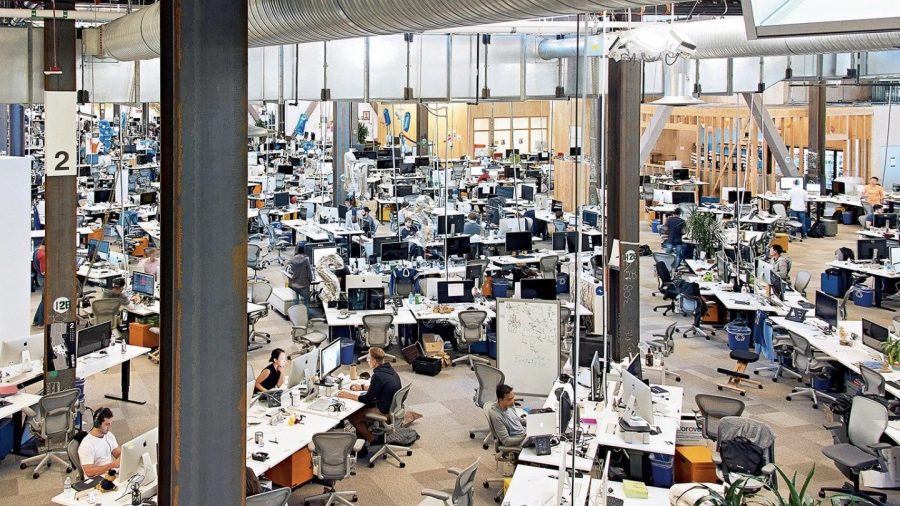

Openspace effect
But is everything so cloudless with open space? Does it really create a sense of cohesion and unity of the team? Let’s look at all aspects.
1. Information overload.
Nowadays, workers are trying to be as mobile as possible and not be tied to the workplace, they can be busy working at the station, in the park on a bench, in a cafe or hotel. You can even say that the whole world is one big open space. In such a situation, even other people’s conversations on the phone can cause information and noise overload. Hence the desire of people to retire, including during the working day. Now imagine a person who is also in the office experiencing all these overloads, and at least five days a week. He has to hear the conversations of other colleagues, the sounds of their landlines and mobile phones, and other background noise created by workers and not only processes. Sound pollution and a lack of privacy lead to irritability, distraction, poor mood, and reduced motivation.
2. Damage to health.
Open spaces can harm the health of employees. Here, the density of desktops in one common space plays a role. If we imagine a situation where one of the office workers comes with symptoms of a cold, then what is the probability of infecting the rest of the employees?
But it’s not only that. The Queensland University of Technology for Health and Biomedical Innovation conducted a study, which showed that working in open space increases stress, leads to an increase in blood pressure. Another terrible figure is not in favor of open spaces: the above problems appeared in 90% of employees.
There is also data from a survey conducted among Danish residents, according to which, employees working in open space had 62% more days of absence from work due to illness than their colleagues working in offices.
3. Lowering the quality of labor.
The decline in the quality of work of workers is also a problem of open space. Here, the factors that we listed in the paragraphs above come into play. In a noisy and stuffy office, it can often be difficult to focus even on simple tasks. Constant distraction from the work process leads to a loss of employee productivity. Also, as described earlier, people working in open space are often prone to chronic fatigue.

Alternative: personal workspace
The research group conducted a survey among employees of various companies. The purpose of the survey is to determine which office format is most convenient for them to work in. More than 400 people took part in the survey, 54.3% of which were women and 45.7% were men. Most of the respondents (68.6%) admitted that they are more comfortable working in the office. For survey participants who prefer a cabinet office organization, the main factors in favor of their choice were:
- opportunity to focus,
- peace and quiet,
- lack of domestic problems with colleagues,
- personal space.
Also, all respondents noted an important advantage of the office – it is the ability to discuss confidential issues and freely conduct working negotiations by phone.
Impact of open space on your business
As we can see from the above data, contrary to popular belief, open space is not the most profitable option for your business. Saving on office space and rent for it, as a result, you will get tired and irritated employees with a low level of motivation and a large number of sick days, and such employees cannot do their work efficiently and on time, which, of course, does not have the best effect on performance companies. This is a strong argument for business leaders to rethink the approach to organizing the workspace in the office in the direction of creating more isolated quiet workplaces. And one of the economical options is to install soundproof office cubicles.