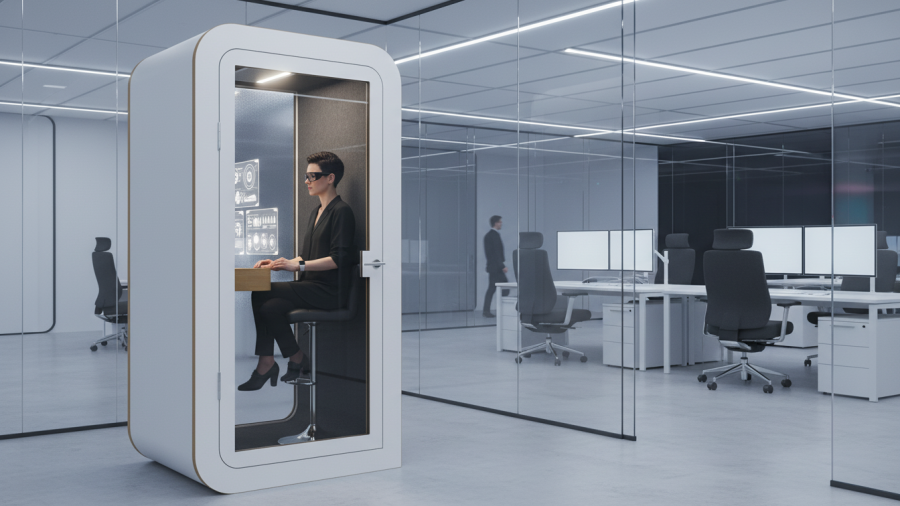
What Is an Office Phone Booth?
An office phone booth is a compact, enclosed space designed to deliver quiet, private, and comfortable conditions for phone and video conversations inside open offices. Unlike the nostalgic city kiosk, today’s Phone booth is an engineered product: a modular phone booth with multilayer materials, acoustic seals, smart ventilation, and integrated power/USB so employees can step in, connect, and communicate without disturbing others. You’ll hear them called an acoustic phone booth, soundproof phone booth, private phone booth, phone pod, call booth, or privacy pod—they all aim at the same outcome: noise-free calling and short bursts of focused work.
Modern office phone booths are typically freestanding, prefabricated units for one or two people, though team-sized models exist. They combine sound insulation (e.g., high-density panels and triplex glass), airflow systems that quietly exchange fresh air, motion-activated LED lighting, and convenient connectivity for laptops and phones. Some models are truly portable; others are semi-permanent but still modular enough to move as floor plans evolve. In practice, they create immediate “focus zones for calls” right where people work—no construction, no disruption, and no compromise on comfort.
The rise of open-plan office noise, the need for confidential conversations, and the shift to hybrid work communication have made phone booths for offices indispensable workplace privacy solutions. In short: they let people talk, think, and decide—without the din of the floor or the fear of being overheard.
How Soundproof Booths Improve Workplace Productivity and Well-Being
Adopting soundproof office phone booths solves a daily operational challenge: too much noise and too little privacy. When conversations spill across an open floor, cognitive load spikes, errors creep in, and collaboration suffers. Well-designed office phone booths restore balance by offering acoustic call spaces that support private calls at work, frictionless video conferencing, and short, focused sessions. The benefits reach beyond productivity: they reduce stress, enable hybrid schedules to run smoothly, and signal to employees that their time and attention matter.
In effect, phone booths for offices are small assets with outsized impact. They improve the experience of work.
Reducing Noise and Distractions
Open-plan office noise is not trivial. Studies from organizations such as the WHO and McKinsey have cataloged the cognitive toll of interruptions, with recovery times measured in minutes, not seconds. A soundproof phone booth acts as a dependable buffer, delivering a noise-free calling environment and sharply reducing spillover chatter. Colleagues nearby stay focused; the caller gains clarity.
Consider a simple scenario: before booths, sales reps mishear details during discovery calls and spend extra time following up; after installing call pods for offices, miscommunications drop and call satisfaction rises. The effect compounds—more accurate notes, better client rapport, fewer “sorry, could you repeat that?” moments. Quiet creates quality.
Enhancing Privacy for Calls and Meetings
Some conversations must be private—HR discussions, sensitive negotiations, confidential conversations with clients. An acoustic phone booth designed for speech privacy ensures intelligibility drops outside the booth while preserving clear audio inside. While “soundproof” is often used broadly, informed buyers look to technical measures such as STC/Rw ratings to distinguish between basic speech privacy and near-confidential performance. The higher the rating, the better the isolation.
Practical features matter too: bookable time slots, presence sensors, and integration with scheduling systems turn a private phone booth into a dependable resource. Employees can plan their day, trust the space, and speak freely—exactly what a modern enterprise needs.
Supporting Neurodiversity and Inclusivity
For neurodiverse employees and anyone with sensory sensitivities, a quiet phone booth can be a sanctuary. Reduced stimulation, steady lighting, comfortable seating, and predictable acoustics lower stress and support sustained attention. Organizational inclusion initiatives increasingly recognize the value of providing low-stimulation, acoustic call spaces alongside collaborative zones.
Design flexibility helps. Options for booth size (solo to four-person), light color temperature, finishes, and seating allow teams to configure calm spaces for a broader range of needs. Inclusivity isn’t an add-on; it’s designed in.
Key Features and Selection Criteria for Office Phone Booths
Not all office phone booths are created equal. To achieve true workplace privacy and acoustic comfort, buyers should look beyond marketing language to the specifics: measurable acoustic performance, airflow that stays quiet, seamless technology integration, and clear evidence of compliance and sustainability. Each dimension has a direct impact on the employee experience and the booth’s ROI.
Soundproofing and Acoustic Performance
A booth qualifies as a soundproof phone booth when it meaningfully attenuates speech and office noise and controls internal reverberation so voices sound clear, not boomy. Key measures include:
- STC/Rw: How much sound transmission is blocked through walls/doors. Look for lab-tested results under ASTM E90 or ISO 10140 and ratings summarized per ISO 717.
- Reverberation: Internal absorption that keeps echo low for natural speech and video calls.
Materials and construction do the heavy lifting. Triplex (three-layer) glass reduces resonance; dense, absorptive wall panels dampen internal reflections; precise door seals stop leaks. For reference, well-engineered models like Silentbox Solo and Duet target up to ~35 dB reduction in speech-frequency bands, enough to keep outside intelligibility low while preserving call clarity inside.
Two frequent failure points are instructive:
- Door seals that don’t fully seat, creating audible leaks.
- Flanking paths (e.g., through ventilation penetrations) that bypass the main structure.
Request third-party acoustic reports, not just claims. It’s the difference between hope and proof.
Ventilation and Air Quality
Comfort requires fresh air. Without it, CO2 and odors build quickly in small enclosures, leading to fatigue and reduced performance. ASHRAE 62.1 provides guidance on minimum ventilation rates for enclosed spaces; translated to booths, that generally means a steady, measurable air exchange sized to occupancy and volume.
High-performance booths reconcile airflow and silence. They use silencers, baffled ducting, and smart fans to maintain fresh air without undermining isolation. Buyers should check:
- Published airflow (m³/h) matched to capacity.
- Noise levels in dBA while fans operate.
- Sensor-based control that ramps ventilation during use.
Silentbox booths illustrate this balance: Solo exchanges ~30 m³/h with silencers; Duet scales to ~90 m³/h; Solo Lite employs two high-capacity fans (~160 m³/h each) governed by smart controls. The result is fresh, quiet air that supports long calls and short meetings alike.
Integration with Office Technology
An office phone booth becomes indispensable when it plugs into the digital workplace. At minimum, look for:
- Power and charging: 220 V outlets plus USB/Type-C for devices.
- AV readiness: space and ports for displays and peripherals; reliable WiFi access.
- Booking integration: sync with room/desk scheduling tools so usage is visible and manageable.
Smart features amplify value: occupancy sensors, booking displays, and CO2 monitors help facilities teams maintain, clean, and optimize. Silentbox’s lineup includes 220 V sockets with USB ports across models, sensor-activated lighting/ventilation, and compatibility with scheduling platforms—practical enablers of hybrid work communication and operational efficiency.
Compliance and Sustainability
Compliance is non-negotiable. Verify documentation for:
- Fire performance (e.g., ASTM E84 flame-spread).
- Electrical safety per local code.
- Accessibility (ADA) considerations for approach, thresholds, and hardware.
- Acoustic testing (ISO 10140/717) to validate performance.
Sustainability adds long-term value. Low-VOC finishes, recyclable components, and energy-efficient LEDs/fans reduce environmental and health impacts. A modular phone booth that can be relocated and reconfigured supports circularity and real-estate agility, aiding LEED or BREEAM aspirations and lowering lifecycle costs. Silentbox emphasizes natural materials, efficient electronics, and modular design—choices that pay back in both well-being and total cost of ownership.
Transforming the Modern Workplace with Soundproof Solutions
By 2026, organizations that master acoustic comfort will outpace those that don’t. Soundproof office phone booths anchor a balanced environment: open enough for teamwork, yet equipped with quiet, bookable spaces for concentrated communication. The data is consistent across workplace studies—employees report higher satisfaction, faster task completion, and improved meeting quality when spaces support varied modes, including private conversations.
Strategically, the advantages are compelling. A portfolio of office phone booths—Solo for quick calls, Duet for interviews, Quartet for huddles, plus Lite versions for smaller footprints—lets companies right-size rooms without heavy construction. This optimizes real estate, strengthens the workplace brand, and gives leaders a lever for talent attraction and retention. In short, the modern phone booth for calls is not a luxury; it’s a core asset for resilient, future-ready offices.
Silentbox EN brings this strategy to life with engineered details that matter: triplex glass, absorptive felt panels, motion-activated LEDs, quiet ventilation with silencers, and ready-to-use power and USB. Options range from the compact Solo and Solo Lite to the collaborative Duet, Duet Lite, and Quartet series—each configurable in color, finishes, and furnishings to match your brand and floor plan.
FAQs about Office Phone Booths
How do I verify soundproof performance of a phone booth?
Ask for independent lab reports following ASTM E90 or ISO 10140/717; these show measured transmission loss and are the only reliable proof of a soundproof phone booth’s performance.
What maintenance is required for office phone booths?
Plan for regular cleaning, periodic filter replacement for ventilation, and quick inspections of door seals, sensors, and power/USB to ensure consistent acoustic and user performance.
Are Silentbox booths customizable for size and finish?
Yes. Silentbox offers customization across dimensions, colors, interior finishes, and furnishings—so each private phone booth fits your brand and spatial constraints.
Do Silentbox booths support third-party booking systems?
They do. Silentbox booths can integrate with existing office scheduling or booking platforms, enabling analytics, cleaning rotations, and dependable availability.
What certifications or standards should office phone booths meet?
Look for ISO 10140/717 (acoustics), ASTM E84 (fire), ASHRAE 62.1 (ventilation), ADA accessibility requirements, and compliance with local electrical and safety codes.
Ready to create a quieter, more productive office? Explore Silentbox EN’s range—from the open office phone booth that streamlines daily calls to a quiet phone booth for HR, client work, or hybrid meetings. Choose a modern phone booth that elevates focus, privacy, and well-being across your workplace.