From Pandemic to Purpose: How Hybrid Work Transformed Office Investment Strategies
/office-booths
The pandemic didn’t just change where we work; it changed what we need when we come together. Office booths have moved from a niche amenity to a strategic asset, allowing organizations to combine openness with privacy, flexibility with focus, and style with measurable performance. This article explores why that shift matters—and how to invest wisely.
What Are Office Booths and Why Are They Important?
As hybrid models normalized, the office’s role sharpened: collaboration, culture, and high-value tasks that benefit from in-person energy. Yet open plans still suffer the same old issues—noise, interruptions, and lack of privacy. Office booths bridge that gap. They carve out pockets of acoustic comfort and reliable privacy inside bustling spaces, preserving the energy of open layouts while adding the control knowledge work demands. In short, they are the work-ready rooms your floorplan was missing.
The change is practical, not theoretical. Individual focus, quiet calls, ad hoc huddles, and seamless video meetings are now everyday moments that define employee experience. By turning underused corners into high-utility zones, office booths transform open offices into adaptable ecosystems where people actually want to work.
Definition of Office Booths
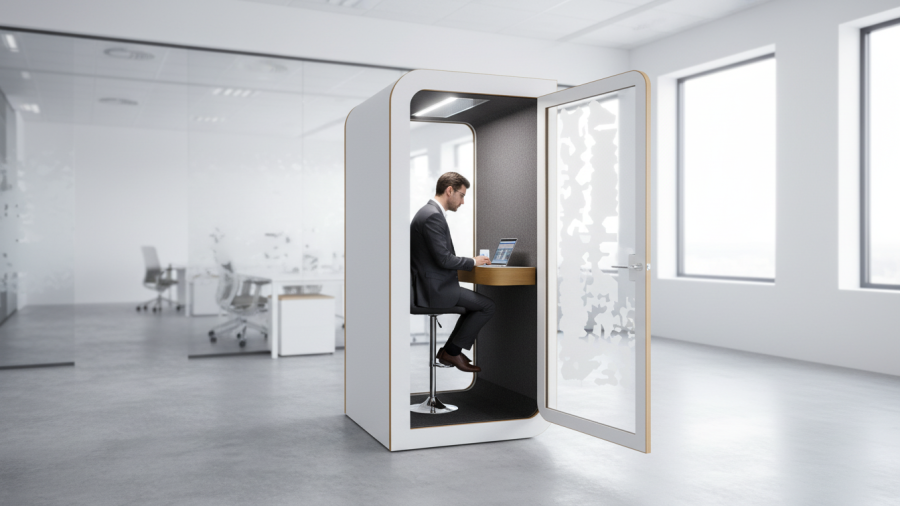
An office booth is a compact, enclosed, modular unit placed within a larger workplace to provide a controlled environment for short-term use—calls, video meetings, interviews, or heads-down work. Think of it as a purpose-built microspace, not a permanent room. An acoustic office booth focuses on materials and construction that optimize sound absorption and intelligibility inside, while a soundproof office booth prioritizes blocking noise in and out for speech privacy. A private office booth emphasizes visual discretion and comfort for confidential conversations. Meanwhile, an office phone booth is typically a smaller, single-user variant optimized for calls and quick video sessions.
Key terms worth defining:
- Acoustic privacy: The ability for conversations to remain intelligible to participants and unintelligible to bystanders—often achieved by sound isolation and interior sound absorption.
- Soundproof pod: A freestanding, mobile enclosure engineered to reduce sound transmission and control reverberation.
- Modular office booth: A prefabricated, plug-and-play structure designed for swift installation, relocation, and reconfiguration without major construction.
These are not traditional conference rooms. They are smaller, faster-to-deploy, high-performance spaces that complement meeting rooms and desk areas.
Main Types of Office Booths
While designs vary, most solutions fall into a few clear categories based on use case and technology integration. Phone/focus units provide instant relief from ambient noise; meeting pods enable private collaboration; and AV-optimized booths support reliable hybrid communication. In practice, organizations often deploy a mix to balance privacy and collaboration across the floor.
Common types include:
- Phone/focus booths: Single-person units used as a phone booth for office calls, quick video meetings, or individual concentration.
- Meeting/huddle booths: Two- to four-person pods offering a private meeting space for interviews, pair work, or agile collaboration.
- Videoconferencing booths: Enclosures with integrated AV, lighting, and acoustics tuned for remote-first communication quality.
Installations range from plug-and-play models that assemble in hours to more integrated versions that interface with building systems. The modular design of most units makes scaling and moving straightforward.
Key Benefits of Office Booths
Organizations adopt office booths to achieve tangible, day-one improvements in workplace quality and performance. The benefits extend from employee experience to space planning and cost control.
- Acoustic privacy in noisy environments: High-grade noise reduction and interior acoustic treatment ensure conversations stay inside the pod and distractions stay out.
- Flexible workspace without construction: Deploy, relocate, or add units as teams grow. Avoid the cost, delay, and rigidity of permanent walls.
- Private meeting space on demand: Right-sized rooms for 1–4 people reduce conference-room bottlenecks and increase utilization.
- Productivity in open offices: By minimizing noise and visual interruptions, booths support deep focus and reduce context-switching.
- Hybrid-readiness: With reliable AV, lighting, and power, booths make it easy to drop in for virtual meetings or confidential work any day of the week.
The result is straightforward: better work outcomes, higher employee satisfaction, and a workplace that supports retention in a competitive talent market.
How Office Booths Transform Hybrid Work Environments
Hybrid work exposed a paradox: people come in for collaboration and culture, yet they still need quiet, secure corners to perform. Office booths solve this by layering privacy on top of open plan agility. They make it possible to host a sensitive HR conversation and, 20 minutes later, run a high-stakes client video call in the same footprint. That versatility is the point.
Supporting Focused Work and Privacy
On in-office days, employees need spaces for tasks they can’t easily do at home: confidential calls, undisturbed analysis, or a video pitch where lighting, acoustics, and bandwidth just work. A quiet office booth provides the right conditions—low reverberation, solid sound isolation, and visual privacy—so people can focus without booking a large room. This is where the difference between intent and outcome is critical: quality engineering is what turns a booth into a dependable focus room.
Consider Silentbox Solo—a single-user soundproof pod engineered to reduce noise by up to ~35 dB in the critical 150–500 Hz speech band, with automatic LED lighting and motion-triggered ventilation delivering ~30 m³/hour of fresh air. It’s effectively an office phone booth you can trust for clear audio, even in open offices with steady activity.
Reducing Noise and Enhancing Collaboration
Noise is not just a nuisance; it erodes attention and makes teamwork harder. An open plan office booth absorbs and contains the chaos, improving the entire floor’s soundscape. For small-group collaboration, a soundproof office booth provides speech privacy and consistent audibility—no raised voices or awkward echoes—so teams can move faster without a full conference room.
Two- to four-person solutions such as Silentbox Duet and Silentbox Quartet illustrate the point. With up to ~35 dB noise reduction, acoustic wall panels, and triplex glass, they function as an office meeting booth that benefits both occupants and neighbors. Silentbox Duet’s ventilation scales up to ~90 m³/hour, keeping discussions clearheaded and comfortable during longer sessions. In essence, a well-designed soundproof pod supports both focused solo work and dynamic huddles in a single, flexible asset.
Enabling Flexible Space Utilization
Hybrid schedules and fluctuating occupancy demand agility. Here the modular office booth shines: it can be moved, reconfigured, or added as teams evolve—without permits, dust, or downtime. This adaptability reduces investment risk compared with permanent construction and aligns neatly with coworking solutions that regularly re-plan floors.
Silentbox’s Lite series underscores this flexibility. Silentbox Solo Lite and Duet Lite deliver lighter structures with SMART controls for ventilation and lighting, while maintaining strong acoustic performance and integrated power. In fast-changing environments, adding a modular office booth is a capital-light way to right-size your mix of focus and collaboration spaces, week by week.
Key Considerations for Selecting and Implementing Office Booths
Decisions should be anchored in performance and user outcomes, not just aesthetics. Success comes from matching product capabilities to defined work modes—confidential calls, daily standups, high-stakes video—and verifying that real-world results meet expectations.
Acoustic and Ventilation Performance
Acoustics and air quality should top the list. Look for published, third-party-verified metrics such as Speech Level Reduction (per ISO 23351-1) and sound reduction index (Rw), alongside interior reverberation time (RT60). As a rule of thumb, target meaningful speech privacy (often 30–35 dB reduction in speech frequencies) and interior RT60 below ~0.5 seconds for clarity. Many premium models, including Silentbox Solo and Duet, specify up to ~35 dB reduction in the 150–500 Hz band—a strong indicator for office speech masking.
Ventilation matters just as much. Follow ASHRAE 62.1 principles to provide adequate outdoor air per person; in practice, this often equates to 20–40 m³/hour per occupant or 6–10 air changes per hour, supported by motion sensors and quiet fans with silencers. Silentbox Solo supplies ~30 m³/hour for one user, while Duet scales to ~90 m³/hour for two—helping maintain CO₂ levels and comfort during back-to-back meetings. Avoid pitfalls like weak door seals, inadequate extraction, or noisy fans that undermine the booth’s purpose. Field commissioning to confirm acoustic performance and airflow is worth the effort.
Technology Integration and Accessibility
A modern office booth should simplify work, not complicate it. Prioritize power and connectivity: AC outlets for laptops, USB and USB-C charging, and stable network options for video calls. Smart features like occupancy sensors, automatic LED lighting, and integrated controls reduce energy use and user friction. Many organizations also integrate booking tools so employees can reserve a booth alongside conference rooms.
Accessibility is non-negotiable. Ensure door clear widths (at least 32 inches / ~815 mm), level thresholds, adequate turning space for wheelchairs, and reachable controls (15–48 inches / ~380–1220 mm above the floor). Provide equitable distribution across floors so accessible units are genuinely available. Silentbox models include thoughtful ergonomics—like sensor-based lighting/ventilation and reachable power modules—so more people can use them comfortably.
Sustainability and Material Choices
Sustainability and health go hand-in-hand. Seek low-VOC finishes, recycled or renewable acoustic materials (such as PET felt), and responsibly sourced wood. Energy-efficient LED lighting at neutral color temperatures and quiet, efficient fans with sensor-based controls reduce ongoing environmental footprint. Modular construction supports circularity: reconfigure or relocate instead of demolishing, and plan for end-of-life disassembly and recycling.
For organizations targeting LEED or WELL, look for documentation such as EPDs and low-emitting material certifications. Silentbox emphasizes premium natural materials, triplex glass that manages resonance, and smart electronics that reduce idle consumption—choices that align with both ESG commitments and occupant well-being.
Unlocking Value with Office Booths for the Modern Workplace
When you translate features into outcomes, the business case comes into focus: higher employee satisfaction, reduced distraction, and better space utilization. Instead of building more meeting rooms, consider a distributed network of booths that places privacy where people actually work—near teams, not down the hall.
A simple ROI lens helps. Imagine deploying eight booths across a 40,000-square-foot hybrid office. If 120 employees each reclaim just 30 minutes of focused time per week thanks to noise reduction and fewer booking conflicts—and you value time at $60/hour—you recover roughly $3,600 weekly, or about $187,000 annually. Add savings from avoiding permanent construction and the benefit of 20–35 day deployment windows, and the payback period becomes compelling.
Real-world examples are instructive. A scale-up replaced two underused small meeting rooms with four Silentbox Duet units and two Solo units positioned near sales and engineering. The result: fewer missed video calls, shorter waits for private meeting space, and faster turnarounds on customer conversations. By distributing acoustic office booth capacity at points of need, they improved both collaboration and focus in a single strategy.
Looking ahead, the modern office booth will be a standard building block in flexible workplace design. It will carry the load of hybrid work’s most common, high-value activities—confidential calls, small-group collaboration, and video-first meetings—while allowing real estate and facilities teams to adapt quickly as needs shift. That agility is the new advantage.
Explore how Silentbox can help: Solo for single-user focus and calls, Duet for two-person collaboration, and Quartet for small team sessions—plus lighter, space-efficient Solo Lite, Duet Lite, and Quartet Lite variants. With acoustic engineering up to ~35 dB noise reduction, triplex glass, SMART ventilation and lighting, and integrated power, Silentbox delivers a private office booth experience that fits today’s flexible workspace realities.
Frequently Asked Questions about Office Booths
How easy is it to install or relocate office booths?
Office booths are designed for straightforward, modular installation and can typically be assembled or relocated within a day without major construction. Most units ship flat-packed and are reconfigurable as your layout changes.
Can office booths be customized for brand or interior style?
Most office booth manufacturers offer customization options for colors, finishes, and materials to match brand standards or office interiors. Some, including Silentbox, also offer interior options like seating styles and back-wall finishes.
What standards do office booths need to meet?
Quality office booths should comply with building codes, acoustic and fire safety standards, ventilation requirements, and ADA accessibility guidelines as applicable. Look for ISO-referenced acoustic data and adherence to ASHRAE ventilation principles.
Are office booths accessible for all users?
Accessible models are available, but always confirm dimensions, clear floor space, and reachable controls to ensure full compliance for users with disabilities. It’s best practice to distribute accessible units throughout the floorplate.
How are office booths maintained and cleaned?
Office booths are typically maintained with routine cleaning and periodic servicing of ventilation filters, surfaces, and any built-in technology. Most surfaces are specified for commercial-cleaner compatibility.
What is the lead time for delivery and installation?
Lead times for delivery and installation generally range from two to six weeks, depending on customization and shipping logistics. Silentbox typical delivery windows run ~20–35 days.
How do office booths support sustainability goals?
Many modern office booth designs use sustainable materials, energy-efficient systems, and are built with modularity for re-use or recycling at end of life. Documentation can also support LEED or WELL contributions.
Silentbox at a glance: Solo (110 × 105 × 220 cm; ~35 dB; ~30 m³/h), Duet (210 × 110 × 220 cm; ~35 dB; ~90 m³/h), Quartet (from 210 × 138 × 220 cm), and Lite series including Solo Lite (105 × 107 × 223 cm; two fans at ~160 m³/h each) and Duet Lite/Quartet Lite with SMART controls. Each model combines noise reduction, triplex glass, LED lighting, and integrated power—so your open plan office booth strategy delivers measurable results from day one. Whether you need an office meeting booth for collaboration, a quiet office booth for focus, or a soundproof office booth for sensitive calls, Silentbox helps you build a workplace booth network that scales with your business.