Unlocking Employee Potential: 7 Key Productivity Strategies
Open-plan and hybrid offices promise collaboration, but they also amplify distractions—ringing phones, spontaneous conversations, and video calls that spill into shared space. For leaders tasked with improving performance, the challenge is to protect focus without slowing teamwork. That is where acoustic office pods come in: practical, elegant enclosures that carve out quiet, private zones inside the office so people can think, meet, and communicate at their best. In the pages that follow, we explore how these pods translate directly into measurable productivity gains.
What Are Acoustic Office Pods?
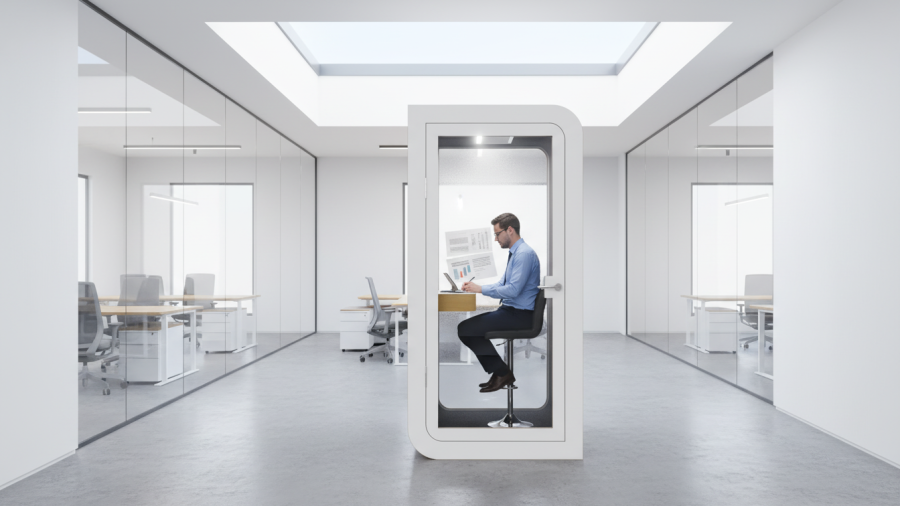
At their core, acoustic office pods are freestanding, modular enclosures placed within an existing workspace to create quiet, private areas. Unlike traditional meeting rooms, they don’t require construction permits or long build-outs. Instead, they arrive as prefabricated units with sound isolation, integrated ventilation, motion-activated LED lighting, and power—ready to plug in and use. Picture a compact room-within-a-room that sits on your floorplate and instantly adds privacy without the headaches of a renovation.
There are several common formats. Single-person booths function as a focus room or privacy booth for calls and deep work. Two-person pods support interviews or quick huddles. Larger pods—designed for up to four people—serve as small meeting spaces and collaboration hubs. For example, Silentbox offers Solo (1 person), Duet (2 persons), and Quartet (up to 4 persons) as well as lighter-weight “Lite” versions to suit smaller footprints or mobile teams.
These pods differ from built rooms in three important ways: flexibility, speed, and scalability. Because they’re modular, you can move them, reconfigure them, and add more as the organization grows—without disrupting daily operations. And because quality models include acoustic wall panels, triple-layer (triplex) glass, and sealed joints for noise reduction, they deliver true privacy with comfort. Imagine stepping into a quiet, well-lit, climate-stable space with a shelf, seating, outlets, and USB ports—everything within reach for productive work.
As open-plan design and hybrid workspace norms become the standard, the case for in-office privacy is stronger than ever. That’s why acoustic office pods are increasingly visible in modern offices: they deliver flexible workspace and privacy on demand, without construction. Next, we’ll connect these features to the outcomes that matter most—productivity and performance.
How Acoustic Office Pods Boost Employee Productivity
Work environment is a consistent predictor of performance. Research in applied cognitive psychology shows that speech noise impairs recall, reading comprehension, and sustained concentration. Industry surveys repeatedly rank noise and lack of privacy among the top inhibitors of productive work in open-plan settings. The result: more context switching, slower output, and increased fatigue—all of which compound across teams.
Acoustic office pods address these challenges head-on. By materially reducing ambient noise and providing reliable speech privacy, they help employees stay in flow longer and recover focus faster after interruptions. They’re not just a policy or etiquette fix; they’re a built, environmental solution that can be measured in decibels, minutes of uninterrupted work, and higher-quality conversations. With integrated ventilation and lighting, pods also support well-being, which in turn sustains performance across the week.
In short, pods remove friction from the workday. And because they’re modular, they scale with your needs. In the next section, we break the opportunity into seven concrete strategies you can put into practice right away.
Seven Productivity Strategies Using Acoustic Office Pods
Organizations don’t achieve focus and speed by accident; they design for it. The following seven strategies translate research and best practices into pragmatic steps any office can implement using acoustic pods. Each strategy blends practical examples with features that make a difference on the ground.
1. Minimize Office Distractions for Focused Work
Everyday office noise—side conversations, Slack call chimes, footsteps—fractures attention and makes deep work rare. Even brief interruptions force costly context switches. A single-person acoustic office pod gives knowledge workers a true quiet zone for heads-down tasks. In practice, it functions as a protected focus room where the risk of interruption is near zero.
Silentbox Solo is a good example: engineered to reduce noise by up to ~35 dB in the speech band (150–500 Hz), with sound-absorbing felt panels and triplex glass for effective sound isolation. Automatic ventilation supports comfort during longer sessions, while motion-activated LED lighting and convenient power/USB keep tools ready. Think of a financial analyst diving into a model, or a designer shaping a critical concept—work that benefits from sustained concentration and minimal distraction.
To make this stick, set norms that protect “deep-work blocks” and make pods easy to book or use as drop-in spaces. Focused individual work is the engine of high-performance teams; an acoustic office pod turns that principle into reliable practice.
2. Provide Private Spaces for Confidential Conversations
Sensitive conversations deserve better than a hallway or a whispered call at the desk. Whether it’s a performance review, an HR interview, or a client negotiation, speech privacy builds trust. A soundproof office pod creates an acoustically isolated environment where outside listeners cannot intelligibly perceive speech.
In practical terms, look for robust sound insulation and low speech transmission, so words don’t leak into the open area. Silentbox booths use triple-layer glass, tight seals, and acoustic panels to keep conversations contained. Managers can give feedback, legal teams can discuss terms, and recruiters can interview without compromising confidentiality. When employees know that privacy is truly private, they engage more openly—and decisions improve.
3. Enable Hybrid Meetings and Video Calls
Hybrid work has made video conferencing ubiquitous—and unforgiving. Background noise, echoes, and visual distractions reduce meeting quality for everyone on the call. A well-designed acoustic meeting pod or a private pod with power, USB, and comfortable seating delivers clean audio and professional presence while shielding the office from your meeting.
Silentbox Duet supports two-person hybrid sessions, combining acoustic treatment with smart electronics, LED lighting, and ample ventilation for longer calls. Built-in power and device charging keep gear online, while sound insulation ensures remote participants hear voices—not the office. Pods connect easily to scheduling systems so teams can reserve slots with a click. In today’s hybrid workspace, a reliable pod equals a reliable meeting.
4. Support On-Demand Collaborative Sessions
Agile teams need spaces they can grab in the moment—without derailing others nearby. Traditional conference rooms are often overbooked, oversized, or too formal for a 15-minute huddle. Modular office pods fill this gap by offering reservable, sound-managed collaboration zones that sit right where work happens.
Silentbox offers multiple configurations: Duet for two-person working sessions and Quartet for groups up to four. Acoustic treatment keeps conversations clear inside and quiet outside, while integrated tables, sofas, and lighting make sessions comfortable and efficient. Typical use cases include:
- A product trio jumping in to resolve an urgent quality issue.
- A sales duo rehearsing a pitch before a client call.
- A cross-functional huddle to plan a sprint backlog.
When collaboration is easy and contained, the rest of the office stays focused. And teams move faster.
5. Enhance Employee Well-Being With Quiet Retreat Zones
Well-being isn’t a perk; it’s a productivity driver. A quiet, acoustically comfortable space helps employees reset between demanding tasks, decompress after intense meetings, or manage personal needs. A private acoustic pod with soft finishes, controlled lighting, and steady airflow becomes a small sanctuary inside a busy floor.
Silentbox Solo and Solo Lite balance acoustic comfort with user-friendly design—motion-activated ventilation, LED lighting around ~4500 K, and ergonomic seating options. Employees can recharge in silence, meditate, or simply step out of the noise. Over time, these moments reduce stress and support retention, especially in high-intensity roles where mental recovery is essential.
6. Improve Recorded Content and Virtual Presentation Quality
From onboarding videos to executive town halls, content creation has moved in-house. Yet recording clear audio in an open-plan environment is notoriously difficult. A soundproof office pod—equipped with sound-absorbing panels and balanced acoustics—provides the quiet pod for office use that makes professional-grade content possible.
HR teams can record training modules without retakes, executives can deliver remote keynotes with confidence, and product teams can capture demos that sound as polished as they look. Silentbox’s acoustic design and stable lighting simplify setup while ensuring consistent quality. The result: clearer communication, stronger brand presence, and fewer reshoots.
7. Scale Privacy and Flexibility Without Major Construction
Building enclosed rooms is slow, expensive, and hard to change later. In contrast, modular office pods are fast to deploy, simple to relocate, and easy to add as demand grows. They install with minimal disruption, integrate seamlessly into different layouts, and move with you if the office expands—or the lease changes.
For example, Silentbox pods typically deliver within ~20–35 days and can be placed wherever they’re needed. As teams evolve, pods can be reconfigured or augmented without permitting or construction crews. When budgets are tight and needs shift frequently, this is the kind of flexibility that future-proofs the office while controlling cost. It’s privacy on demand, not privacy on hold.
Essential Considerations When Choosing Acoustic Office Pods
The benefits are clear, but not all pods perform the same. To capture the full value—focus, privacy, wellness—buyers should look beyond aesthetics and compare technical details. The following considerations help decision-makers specify the right solution for their environment and use cases.
Acoustic Performance and Sound Insulation
The defining job of an acoustic office pod is to reduce audible noise and keep conversations private. Look for meaningful metrics: sound transmission (often expressed as STC or ISO equivalents), insertion loss across speech frequencies, and internal reverberation time to avoid echo. Real-world performance matters more than lab-only claims; ask for field measurements or third-party data.
Construction details drive results: triple-glazed (triplex) glass, sealed joints, dense wall assemblies, and quality acoustic panels. Silentbox pods, for instance, target up to ~35 dB reduction in the 150–500 Hz band for Solo/Duet/Quartet, while Lite models are optimized for lighter-weight installations where ~15–20 dB is sufficient for general calls. Common pitfalls include lightweight panels, leaky door seals, or noisy fans that undermine privacy. For confidential calls, aim for strong noise reduction and low speech intelligibility outside the pod; for deep work, prioritize both external noise reduction and comfortable internal acoustics.
Ventilation, Lighting, and Air Quality
Comfort sustains productivity. Without effective ventilation and lighting, even the best acoustics fall short. Evaluate air exchange rates and noise levels for fans; the goal is steady fresh air without introducing new sound. As a reference, Silentbox Solo provides ~30 m³/hour with silencers, Duet scales airflow to ~90 m³/hour, and Solo Lite incorporates two high-capacity fans (~160 m³/hour each) with smart controls. Systems should meet applicable guidelines (e.g., ASHRAE 62.1) and avoid heat buildup.
LED lighting should be bright enough for reading, with neutral color temperatures near 4000–4500 K for a natural look on camera. Consider motion sensors for automatic control and user overrides for comfort. Finally, prioritize low-VOC materials and cleanable surfaces to support indoor air quality—especially in high-traffic pods.
Compliance, Safety, and Accessibility
Pods are part of a regulated workplace. Confirm that materials meet fire safety requirements, installations respect clearance and egress rules, and electrical systems comply with local codes. Accessibility matters too: wider doorways, low thresholds, reachable controls, and clear floor space support inclusion for all employees. Ensure at least some units meet ADA or local accessibility standards, and coordinate plans with facilities, insurers, and authorities where required. Environmental certifications (e.g., low-VOC labels) are a plus for sustainability goals.
Customization, Integration, and Cost
Customization increases adoption. Options such as finishes, fabrics, and interior furnishings help align pods with brand and culture, while technology integration—outlets, USB/Type-C, AV hardware, and booking systems—ensures frictionless use. Silentbox supports custom colors and interiors across Solo, Duet, and Quartet lines, plus sensor-based controls for lighting and ventilation.
Budget-wise, factors include size, acoustic performance, materials, and custom features. While up-front costs vary, pods often beat the total cost and time of permanent construction—and they move with you. Plan for lifecycle considerations too: warranties (Silentbox: 2 years), cleaning, filter changes, and availability of spare parts. A clear TCO picture will make the ROI case even stronger.
Empower Your Team With a Quiet Workspace
When noise drops and privacy rises, people do their best work—faster, with fewer errors, and more satisfaction. The right acoustic office pod program transforms open-plan environments into high-performance floors where focus, collaboration, and well-being coexist. For leaders, it’s a direct lever for unlocking potential and supporting strategic goals in a hybrid world.
Silentbox delivers a complete portfolio—Solo, Duet, Quartet, and Lite options—that combine advanced acoustic materials, triplex glass, smart electronics, and thoughtful ergonomics. If you’re ready to pilot an open plan acoustic office pod or scale across multiple floors, our team can help you design the mix, integrate scheduling, and customize finishes to fit your brand. Assess your floor today, identify the bottlenecks, and take the first step toward a quieter, smarter, more productive workplace.
Frequently Asked Questions about Acoustic Office Pods
What maintenance is required for acoustic office pods?
Routine tasks include wiping interior surfaces, vacuuming floors, and replacing ventilation filters on schedule, plus periodic checks of lighting and power outlets. Most modern office pods are designed for quick, low-effort upkeep by facility teams.
Can acoustic office pods be moved if the office layout changes?
Yes. Most units are modular and relocatable, allowing teams to disassemble, move, and re-install pods as space plans evolve or when relocating to a new site.
Are acoustic office pods suitable for all office sizes and layouts?
They come in a range of sizes—from single-person to four-person pods—making them effective in compact hot-desking areas, large open floors, and coworking environments.
How do acoustic office pods support accessibility for all employees?
Many models offer wheelchair-friendly doors, low thresholds, and intuitive controls placed within reach ranges, helping organizations meet accessibility standards and inclusive design goals.
What is the expected lifespan of an acoustic office pod?
With proper care, high-quality pods typically last 7–15 years; reputable manufacturers back products with multi-year warranties, often starting at two years.
Are there eco-friendly or sustainable options available for acoustic office pods?
Yes. Look for pods built with recycled or low-VOC materials and energy-efficient lighting and fans—features that reduce environmental impact while supporting indoor air quality.
Note on Silentbox solutions:
- Silentbox Solo: single-person, ~35 dB speech-band noise reduction, automatic ventilation (~30 m³/h), LED lighting, 1×220 V + 2 USB, sensor controls.
- Silentbox Duet: two-person, ~35 dB reduction, ventilation ~90 m³/h, table/sofas, sensor-based control panel.
- Silentbox Quartet: up to 4 persons, scaled ventilation, LED, presence sensors, sofas + table.
- Silentbox Lite series: lighter-weight, compact designs (e.g., Solo Lite with dual fans ~160 m³/h each), smart controls, and customizable finishes.
In practice, deploying the right acoustic office pod mix—whether a modern office pod for individual focus or a private acoustic pod for two—can unlock measurable gains. And for teams that need to scale fast without renovation, a soundproof office pod strategy built around modular office pods is often the most flexible path forward. For executives seeking a single vendor partner, Silentbox offers an open plan acoustic office pod lineup that meets the realities of today’s flexible office—without compromise.