How to Choose the Right Phone Booth for Your Office
Slug
/phone-booth
Understanding Office Phone Booths
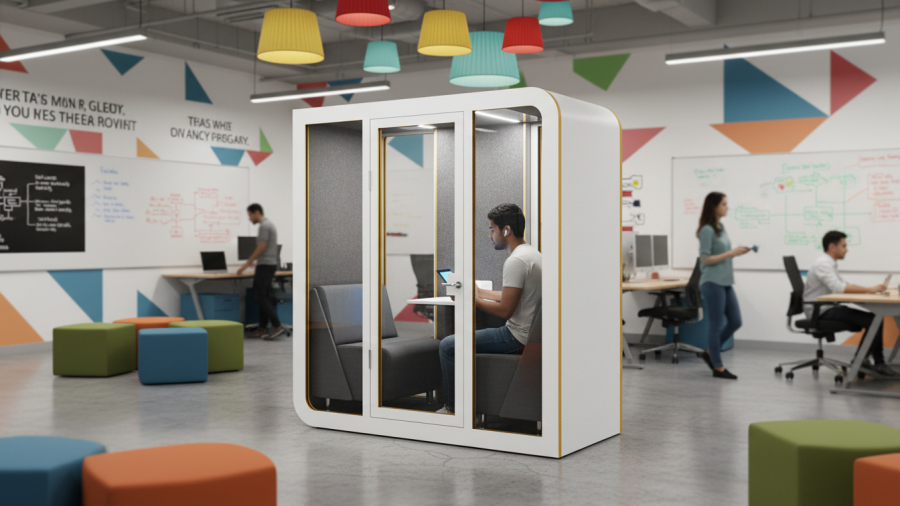
An office phone booth is a compact, purpose-built room-within-a-room designed to create privacy and quiet where open-plan noise is the norm. Unlike a public street phone booth, today’s indoor solutions are engineered for knowledge work: confidential calls, video meetings, focused tasks, and quick huddles. You’ll also see these described as a soundproof phone booth, acoustic phone booth, quiet phone booth, call booth, or phone pod—different labels for the same goal: reliable workplace privacy inside modern offices.
The shift to open plan layouts and a growing hybrid workspace culture made this category essential. When people split time between home and office, they come in to collaborate—and still need dependable places for uninterrupted calls and heads-down work. A modern phone booth restores balance without building new walls.
Productivity follows privacy. When employees have immediate access to a well-designed office phone booth, they can drop into a meeting, take a sensitive call, or focus for thirty minutes without derailing colleagues or themselves. That’s why leading organizations invest in open office phone booth solutions as part of a larger strategy to reduce distractions and improve well-being.
In short, an office phone booth gives teams flexible, on-demand acoustic control—without sacrificing the openness that makes contemporary workplaces feel connected.
Criteria for Choosing a Phone Booth
Acoustic Performance and Sound Insulation
“Soundproof” in this context means the booth prevents the intelligibility of speech from escaping and blocks distracting noise from entering. Vendors typically quote decibel (dB) reduction or the ISO 23351-1 standard for office pods, which measures speech privacy performance. As a rule of thumb, aim for around 35 dB reduction for confidential conversations; lower figures can work for quick calls, but they won’t satisfy when sensitive topics are discussed in an open office phone booth.
Ask for test data you can compare. ISO 23351-1 reports provide a common reference, while simple dB numbers should be backed by lab or field measurements. Materials and construction drive results: multi-layer “triplex” glass, dense acoustic panels, airtight seals, and solid door hardware matter. Silentbox, for example, engineers its structures with sound-absorbing felt and three-layer glass to achieve up to ~35 dB reduction in typical office speech frequencies.
The consequence of under-specifying is predictable—leakage of speech, lingering distractions, and unmet expectations. A well-engineered soundproof phone booth pays off daily by preventing interruptions and keeping conversations truly private.
Ventilation and Indoor Air Quality
Comfort is nonnegotiable. Inside a workplace phone booth, CO2 and heat can build up rapidly without active airflow. Target ≥10 liters per second (L/s) of fresh air per occupant and aim to keep CO2 below 1000 ppm for sustained comfort. Just as important, ventilation must be quiet and decoupled from the cabin so it doesn’t compromise acoustic isolation.
Check air exchange rates and how they scale with occupancy. As examples, Silentbox Solo delivers roughly 30 m³/hour—appropriate for single users—while Silentbox Duet scales to about 90 m³/hour for two-person meetings. Lite models employ dual high-capacity fans with smart control to keep air fresh without adding hum. Look for silencers on ducts, low dBA fan ratings, and, where possible, smart sensors that modulate airflow based on presence.
When airflow is right, people stay longer, think clearer, and choose the booth again. That’s the litmus test for adoption.
Lighting and Visual Comfort
Good light elevates every use case—video calls, reading, and focused work. Inside a modern phone booth, look for uniform, flicker-free LED lighting with at least 300–500 lux at desk height, a neutral color temperature (around 3000–4000 K), and CRI ≥80 so skin tones and documents look natural on camera. Adjustable or sensor-based dimming helps users find their sweet spot without fiddling.
Visual privacy also matters. Clear glass can open the space and reduce claustrophobia; frosted sections or smart placement can shield screens from passersby. Silent, automatic controls avoid fiddly switches and keep the experience seamless.
Lighting done right reduces eye strain and presents users well on video—small details that bring outsized confidence.
Ergonomics and User Experience
Ergonomics in a phone booth is the sum of comfort, layout, and intuitive controls. Seating height and style, the depth and stability of a shelf or table, and legroom define whether a 20-minute call remains comfortable or becomes a fidget. A practical workstation supports a laptop, a notebook, and a cup—without cable clutter.
Look for thoughtful touches: motion sensors that trigger ventilation and lighting, bag hooks, cable pass-throughs, and easy-to-reach power. Glass panels can preserve an open feel while acoustic panels maintain privacy—a balance that keeps a private phone booth inviting, not confining. Silentbox booths, for instance, pair wall-mounted tables, stools or sofas, and sensor-based controls to create a frictionless experience.
When the ergonomics are right, people step in and get to work immediately—and that’s the point.
Comparing Office Phone Booth Features and Options
Materials and Sustainability
Material choices define both performance and character. Common combinations include acoustic felt (often PET or wool-blend), laminated triplex glass for stiffness and resonance control, high-density MDF or engineered wood for structure, and carpet or rubber for flooring. Each contributes to acoustic damping, durability, and the aesthetic your brand presents.
Sustainability is increasingly a differentiator. Ask about recycled content in acoustic panels, FSC-certified wood, low-VOC adhesives and finishes, and certifications such as GreenGuard for indoor air quality. This isn’t just ESG signaling; low-emission materials also improve day-to-day comfort for occupants.
Vendors vary in how they balance these priorities. Silentbox emphasizes premium natural materials, acoustic wall panels, and triple-layer glass, with customization options such as fabric or mirrored back walls and a range of finishes. For buyers, the outcome should be an acoustic phone booth that works hard, ages well, and aligns with sustainability commitments.
Connectivity and Technology Integration
Power and connectivity make or break usability. At minimum, expect a 220 V outlet and multiple charging options (USB-A and USB-C) within easy reach. For a hybrid workspace, consider ethernet, robust Wi‑Fi coverage, and wire management that hides clutter from view. Integrated screens can turn a booth into a micro meeting room; occupancy sensors and booking integrations connect the space to your workplace apps.
Differences among brands show up in the details. Silentbox integrates outlets and USB ports across the range, with sensor-based controls for lighting and ventilation and options to tie into scheduling systems—so a booth shows up in calendars just like a meeting room. That level of integration keeps the acoustic phone booth from becoming an island and makes it a dependable node in your collaboration network.
The net effect is simple: fewer friction points, more productive minutes.
Accessibility and Safety Compliance
Accessibility is both an inclusion priority and a compliance requirement. Depending on your region, confirm door width (often 32 inches/815 mm clear or more), low thresholds, adequate handle heights, and turning radii where applicable. Interior layouts should allow safe entry, seating, and transfer.
Safety certifications matter as well. Look for documented fire performance for interior materials, certified electrical components (e.g., CE/UL as applicable), anti-slip flooring, safety-laminated glass, and low-emission materials to protect indoor air quality. When evaluating a modular phone booth, ask vendors for third-party certificates, installation instructions, and maintenance documentation.
Leading providers build to these standards and supply transparent paperwork. That documentation is the difference between a compliant asset and an avoidable risk.
Taking the Next Step for Office Privacy and Productivity
Investing in a soundproof phone booth is a strategic move: it gives teams immediate control over noise, protects confidentiality, and unlocks more productive time in open-plan environments. In a single gesture, you increase flexibility without redesigning the floor plan—an advantage that compounds as your organization grows and work patterns evolve.
A practical path forward is straightforward:
- Align stakeholders on goals: confidentiality, capacity, and utilization targets.
- Translate needs into measurable requirements: dB reduction, airflow per person, lux levels, power/charging, and integration.
- Request independent test reports, safety documentation, and a live demo or pilot installation on your floor.
With Silentbox, you can pilot configurations across sizes—from Solo and Solo Lite for individual focus, to Duet and Duet Lite for two-person meetings, to Quartet and Quartet Lite for small team sessions. Each office phone booth includes smart lighting and ventilation, 220 V power with USB charging, and acoustic materials engineered for speech privacy, backed by a two-year warranty and typical delivery in 20–35 days. It’s a private phone booth that feels connected, a workplace phone booth that employees actually prefer, and a soundproof phone booth you can roll out with confidence.
As hybrid strategies mature, the right open office phone booth becomes core infrastructure—scalable, data-friendly, and reliable. Choose well now, and your teams will feel the benefits every day.
Frequently Asked Questions about Office Phone Booths
How can I verify sound insulation claims for office phone booths?
Request an independent test report (preferably using ISO 23351-1) showing measured decibel reduction, and ask vendors to provide field or lab reports rather than just marketing claims.
What should I expect for cleaning and maintenance?
Expect periodic cleaning of interior surfaces, simple filter changes for ventilation, and occasional inspection of seals and electronics as outlined in the product’s maintenance manual.
Is it possible to move the phone booth after installation?
Yes, most modular office phone booths are designed to be relocated within the office with minimal disruption, but always check weight and assembly requirements for your specific model.
What warranty and support are available for phone booths?
Leading providers typically offer at least a 12–24 month warranty covering structure and electronics, plus ongoing support, with options for extended coverage depending on the vendor.
Can phone booths be integrated with office booking systems?
Many modern phone booths can be integrated with office booking or calendar systems for easy scheduling and occupancy management—ask your supplier about compatibility and setup.
Are Silentbox office pods available for pilot testing?
Silentbox offers pilot installation programs so organizations can trial office pods and evaluate their impact before committing to a full-scale rollout.